The Technology
What concentrating solar systems actually do
Concentrating solar systems use optics — lenses or mirrors — to focus sunlight onto a small area, dramatically increasing its intensity. Where a flat photovoltaic panel converts sunlight to electricity, a concentrating system converts sunlight directly to high-grade heat. Depending on the optical design and aperture, this heat can range from a few hundred degrees to well over 1000°C using only sunlight as the energy source.
At the scale we work — tabletop to small room-scale installations — this opens up applications in materials research, high-temperature fabrication, educational demonstration, and community-scale thermal processing that would otherwise require expensive electric furnaces or fuel-burning equipment.
Our Optical Approach
Fresnel lenses and reflective systems
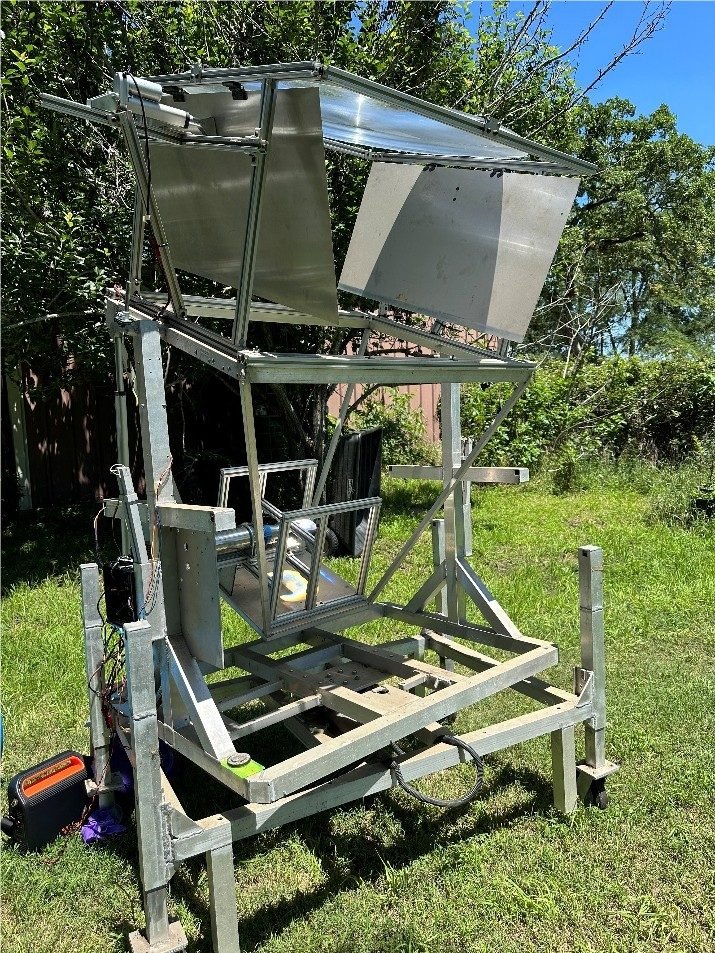
We work primarily with large-aperture Fresnel lenses and custom reflective concentrators. Fresnel lenses offer a practical path to large optical apertures at manageable weight and cost — a key consideration for systems that need to be deployable rather than permanently installed.
We design our optical systems around specific target temperatures and flux densities, and we instrument every system we build to validate that it performs as designed. Optical design, thermal modeling, and measurement are all part of our process.
Applications
What concentrated solar heat can do
Materials Processing
Sintering, melting, annealing, and heat treatment of metals, ceramics, and composites using only sunlight.
High-Temp Fabrication
Glasswork, ceramic firing, and other fabrication processes achievable at solar furnace temperatures.
Research & Characterization
Controlled high-temperature environments for studying material behavior, reaction kinetics, and thermal properties.
Educational Demonstration
Compelling, visible demonstrations of solar concentration for classroom and community settings — real heat, real optics, no fuel.
Community Scale Thermal
Exploring solar thermal at scales useful for community organizations and institutions, not just utility projects.
Cooking & Sterilization
Practical thermal applications in resource-limited contexts where concentrated solar can displace fuel use.
Where We Are
Active research and development
Our concentrating solar work is ongoing and iterative. We are currently developing and characterizing systems at several aperture sizes, improving our thermal measurement instrumentation, and working through optical design challenges around tracking, flux uniformity, and thermal load management at the focal point.
This work is not finished — and that's deliberate. We welcome collaborators at any stage, whether you bring optical design expertise, materials science interest, fabrication capability, or simply a serious research question that concentrated solar heat could help answer.
Context & Scale
Where our work sits in the concentrating solar landscape
Solar furnaces have existed at national laboratory scale for decades — the world's largest at Odeillo, France delivers 1,000 kW at over 3,000°C using 63 heliostats and a 1,830 m² parabolic concentrator covering the area of a large building. These are extraordinary research tools, but they are not community-scale infrastructure.
The gap between national-facility solar furnaces and solar cookers has been largely unoccupied. Our work at Sunstrike Optics, in collaboration with Texas A&M University, is developing compact Fresnel lens systems in the 1–15 m² footprint range — the smallest system footprint in the scale spectrum — targeting 1,000–3,000× geometric concentration and temperatures exceeding 1,000°C.
| System | Power | Concentration | Footprint | Scale |
|---|---|---|---|---|
| Odeillo CNRS (France) | 1,000 kW | 10,000 suns | ~54 × 48 m | National facility |
| PSA SF40 (Spain) | 40 kW | >7,000 suns | ~30 × 20 m | Mid-scale research |
| NREL HFSF (USA) | ~10 kW | 2,500 suns | ~12.5 m² primary | National lab |
| G-C Fresnel (Madrid, 2024) | ~0.8 kW | ~5,000 suns peak | ~10 m² total | Compact research |
| This work — Sunstrike / TAMU | ~0.8 kW per lens | 1,000–3,000× target | 1–15 m² scalable | Community scale |
Key Engineering Insight
Why concentration factor determines temperature
The maximum achievable temperature in a solar furnace is set by the balance between incoming concentrated solar flux and radiative losses from the receiver. At high temperatures, radiative loss dominates — and it scales with receiver area. This is why concentration ratio matters: a system with 1,000× concentration delivers 1,000 times more power per unit area at the focal point than the incoming sunlight, allowing temperatures far above what any flat collector can achieve.
A key advantage of refractive optics (Fresnel lenses) over reflective systems is tracking tolerance: for the same focal length, a Fresnel lens is approximately 2× more tolerant of pointing error than a mirror-based system. This simplifies the tracking mechanics considerably at compact scale — an important engineering consideration for community-deployable systems.
This work lives inside the SHINE initiative
SHINE — Solar Harvesting Innovations for New Ecosystems — is the collaborative initiative where our concentrating solar research connects with community involvement, open development, and a broader network of researchers and builders. If you're interested in this technology, SHINE is where the conversation happens.
Visit SHINE → Contact Us →